

Jesse Woolston Does Not Paint
Reading the Work with Art in the Park’s Director and Curator, Sofija Matich
Reading the Work with Art in the Park’s Director and Curator, Sofija Matich
Reading the Work with Art in the Park’s Director and Curator, Sofija Matich
Jesse Woolston does not paint, at least not in the traditional sense. His storms, waterfalls or standing waves are designed to humble you to the force of nature and make you question - what is my place in this?
In the largest work of his career, and his first major presentation in New Zealand after more than a decade abroad, Woolston will unveil The Infinite Constant Front this November at Art in the Park - a work that takes these natural forces, rebuilds them as governed digital systems, and then places you directly in front of them, on a monumental scale.
From November 12-15, visitors will move through the artwork as they enter the show, the stadium’s illuminated surfaces shifting around them as the piece cycles through its represented forces.
Drawing on fifteen years of learning to see through Aotearoa’s landscapes, oceans and weather, The Infinite Constant Front is a computational work in which nature is encountered as behaviour rather than image, and at a proximity the natural world would never allow. Each phenomenon begins as geographic research and small-scale physical experiment, then becomes a hand-crafted simulation, composed and fixed into a single controlled perspective.
The work will move through four distinct physical conditions, each isolating one mode of nature’s power - standing waves are equilibrium under pressure; tornado dynamics become rotational energy, waterfalls exude gravitational flow, and fire becomes combustion under confinement.
Rendered at enormous scale, these forces are things we would normally meet at a distance, if at all. They’re dangerous, remote, and often unapproachable. Woolston’s work removes that distance and in doing so, makes the encounter both immersive and emotionally sublime.
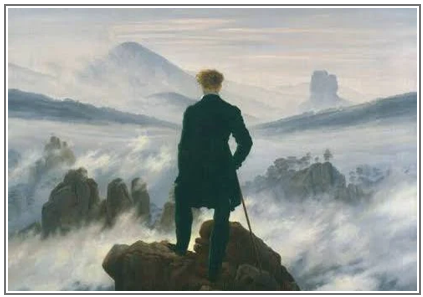
The sublime has long been the language for this feeling, describing the classic philosophical concept of feeling overwhelmed, awed, and small in the face of nature’s immense grandeur. From Caspar David Friedrich’s landscapes to Turner’s storms; the tradition within art history tends to capture nature's power but is often met from a position of safety. Woolston keeps that safety but collapses the traditional distances we experience both physically and immersively - replacing the painted storm with one built from physics. Woolston's pieces are built from beauty, tension and motion, and offered as an experience that you feel before you interpret - an experience that is completely unique.
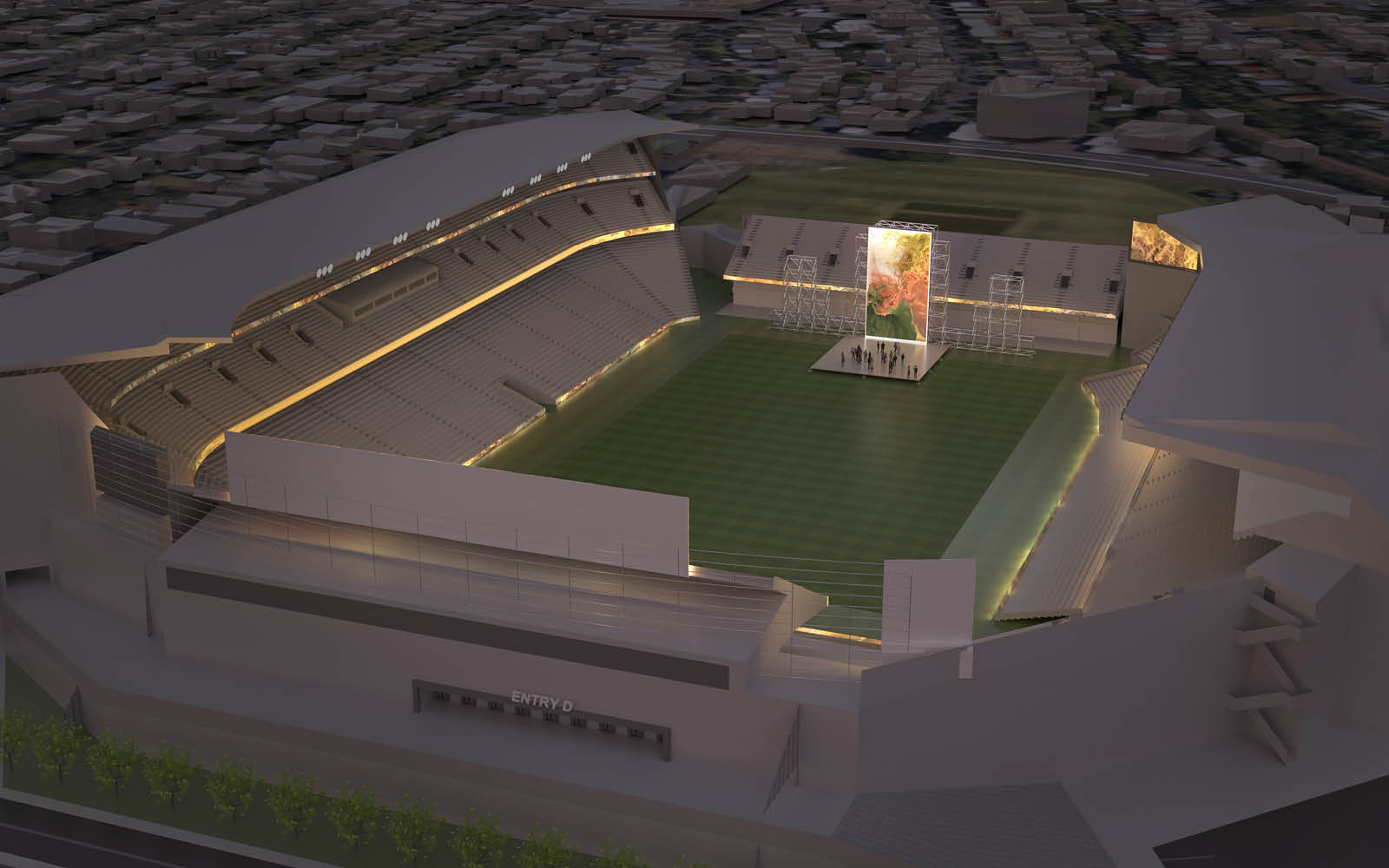
To realise the work at full magnitude, Woolston brings together his entirely original; visual art, composed music, the architecture of Eden Park, and a monumental structure together as one harmonious piece. By synchronising Eden Park’s LED ribbon displays and surrounding surfaces into one continuous system, Woolston transforms New Zealand’s national stadium into an artwork itself - for the first time in its 126-year history. A single field of natural behaviour is in motion, designed to be entered, experienced, and felt.
Woolston’s practice merges computational physics, sculpture, painting and public installation, and it has been presented at significant arts institutions around the world including; the ICA London with Pace Gallery and PROOF during Frieze London. Last year he sold his sculptural work in the Christie’s Post-War & Contemporary Art Day Sale in New York.
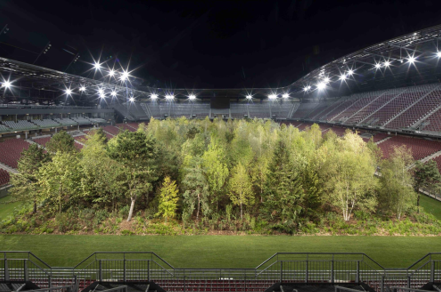
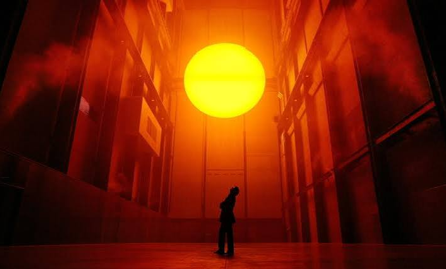
The closest conceptual precedents for his upcoming work at Art in the Park are Klaus Littmann’s For Forest (2019), which installed a planted forest of nearly 300 trees in an Austrian stadium; and Olafur Eliasson’s site specific installation at Tate Modern, The Weather Project, which saw the Turbine Hall transformed into a hazy sunset and where technology was used on a large scale to create an immersive experience of nature. Where Littmann worked with living material, Woolston simulates natural phenomena. Eliasson's work at Tate Modern is comparably more aligned, evoking the experience of the sublime and the collective experience of it, just as Woolston’s does. However, where Eliasson’s work centres on perception and audience behavioural response to the ambient mood created; Woolston adheres to more traditional art historical frameworks for representing the sublime as he adheres closely to the actual dynamics of the weather systems he is recreating. Where Eliasson housed his work in the Tate’s Turbine Hall, Woolston uses the Stadium’s infrastructure as part of the artwork. Arguably, Woolston therefore appears to be the first artist to achieve a stadium-scale reorientation through simulated natural phenomena globally.
Art in the Park is Aotearoa’s national art show at Eden Park and Woolston’s installation, a global first, is a unifying thread for its 2026 programme of exhibiting artists. It expands the remits of what an art show can be, cementing it as a space to hold collective experience via a multitude of ever-expanding channels - a space where collective experience creates connection and growth. Woolston’s work is intended to travel globally after its Auckland premiere, carrying the imprint of the place that shaped it, his home. This is where it begins, and we get to be the first to experience it.
Jesse Woolston does not paint - at least he doesn’t with just a paintbrush. What he does is paint with physics - gravity, pressure and rotation are his pigments - and this November, the stadium is his canvas.
.png)